
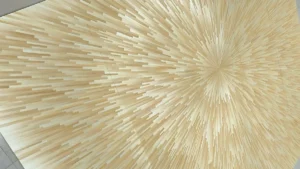
As a wood veneer specialist at CHUANFOO WOOD, I often advise Western furniture manufacturers, interior designers, architects, and contractors on when to specify natural wood veneer sheets—and when to elevate a project with specialty surfaces like straw marquetry. Straw marquetry, crafted from flattened rye or wheat straw, delivers luminous, fiber-rich geometry that feels artisan yet modern. In this insight, I’ll unpack how straw marquetry compares to wood veneer, where it excels, technical considerations for substrates and finishing, and how to integrate it within veneer-driven millwork packages.
In brief: Straw marquetry is a premium decorative surfacing technique that complements natural wood veneer by adding iridescent mosaics and graphic inlays to panels, doors, furniture fronts, and feature walls. Its value lies in hand craftsmanship, optical depth, and pattern discipline—best realized on calibrated cores with balanced backing, sealed edges, and careful finishing. Below, I’ll share practical guidance on selection, fabrication, “2024 veneer finishing techniques,” sustainability claims you can responsibly make, and cost-to-impact strategies for real projects.
Let’s move from trend appreciation to specification clarity.
Designers are rediscovering straw marquetry for its hand-made luminosity and contemporary geometry.

Highlights:
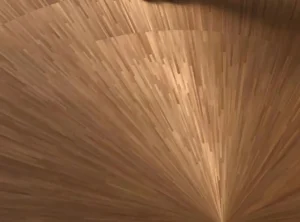
Straw marquetry’s allure lies in its anisotropic sheen—the microstructure of straw reflecting light differently by orientation. When artisans fan, herringbone, or radial-lay strips, surfaces become kinetic as viewers move. This effect pairs beautifully with calm veneer fields like rift-cut oak or walnut, introducing a focal layer without overwhelming the scheme.
Contemporary interiors prioritize texture and tactility with restrained palettes; straw marquetry checks both boxes. Designers use it to signal hierarchy (reception desks, feature doors, cabinet fronts) and to create “moments”—panels that catch ambient light and animate otherwise matte environments. The technique’s renewed popularity also stems from the desire for natural, renewable materials and traceable craft. While production throughput remains artisanal, today’s shops combine hand-laying with CNC-cut carriers and calibrated cores, improving dimensional control and accelerating installation.
Claims statement:
Understanding differences helps you select the right surface for the right zone.

Quick comparison:
Natural wood veneer presents botanical grain—cathedrals, medullary rays, and rift lines. It scales efficiently across large surfaces and accepts standardized finishing systems. Straw marquetry, by contrast, is constructed from narrow straw strips, flattened and cut, then hand-applied to create continuous designs. The result has less visible “wood grain” and more geometric rhythm with glossy highlights.
Performance-wise, both rely on their substrates. Veneer benefits from balanced backers to prevent warp; straw marquetry benefits from smooth, dimensionally stable cores to avoid pattern telegraphing. Veneer edges can be protected with 3 mm lamella or solid edging; straw surfaces often receive protective frames or recesses to minimize edge exposure.
Specifying strategy:
| Feature | Natural Wood Veneer | Straw Marquetry |
|---|---|---|
| Typical face thickness | 0.3–0.6 mm | Thin skins over cores |
| Visual character | Grain, figure, rays | Iridescent, geometric |
| Throughput | High (industrial) | Moderate (artisan) |
| Edge protection | Lamella/solid wood | Frames/lamella trims |
| Repairability | Moderate (refinish) | Localized repairs, pattern-matched |
Claims statement:
Stable cores and balanced construction are non-negotiable for straw marquetry.
Recommendations:
Straw marquetry telegraphs substrate imperfections; therefore, MR MDF is the default for flat, pore-free faces. For doors or high-impact areas, plywood cores may be preferred for their screw-holding and edge durability, with a skim or underlayment ensuring a smooth lay surface. Balanced backing veneers or paper backers help prevent warp arising from humidity changes.
Adhesive selection hinges on shop method. High-solids PVA under vacuum/cold pressing is common, offering reliable bonds without excessive brittleness. PU adhesives can improve moisture resistance and bond across varied materials. Uniform pressure during pressing is crucial to avoid facet ridging. Use clean cauls and release films to keep patterns pristine.
Edge strategy protects the delicate perimeter: recess straw panels by 1–2 mm within a frame, or cap with lamella/solid wood trims. In casework, consider finger-pull designs that keep hands away from panel edges, extending service life.
Claims statement:
Finishes must protect without muting the optical depth.
Preferred systems:
Straw’s gloss arises from surface microstructure; heavy, high-gloss films can create mirror-like glare and possible color shift. Satin and matte waterborne polyurethanes provide protection while maintaining the perceived iridescence. Apply thin seal coats first to lock fibers, then 2–3 topcoats with light scuff sanding (220–320 grit). Avoid aggressive sanding that could thin or burnish straw facets unevenly.
UV-cured systems are ideal for shop-throughput and consistent film builds. They deliver scratch resistance and chemical durability with low VOCs, but require process tuning to keep the finish optically “quiet.” Hardwax oils offer tactile warmth and easy spot repair; they suit boutique residential panels away from heavy contact but may lack stain resistance for hospitality bars.
Color tuning is minimal compared to wood veneer; most clients prefer straw’s natural tone. If tonal blending is necessary across batches, test clear sealers under project lighting. Edge protection includes extra coats around pulls and corners.
Claims statement:
Place straw where its light play delivers maximum design value.
High-impact use cases:
Straw marquetry’s sweet spot is focal surfaces that benefit from dynamic sheen—doors, fronts, and framed panels. In public interiors, use sequence planning to repeat pattern rhythms while allowing subtle variation for authenticity. Recess panels within stone or metal surrounds to enhance contrast and shield edges. In residential projects, cabinet fronts with straw inlays can lift minimal kitchens or dressing rooms without overwhelming the palette.
For workspaces, consider straw marquetry on reception desks or feature walls where illumination can be choreographed—wash lights at low angles accentuate iridescence; diffuse lighting softens sparkle. On furniture, protect horizontal surfaces with glass or metal top rails in high-use environments. Combine straw panels with natural wood veneer carcasses and lamella edges to harmonize textures and control costs.
Claims statement:
Smart integration balances cost, craft, and maintenance.
Integration strategies:
A practical specification pairs MR MDF or plywood carcasses surfaced with natural wood veneer for continuity and resilience, while allocating straw marquetry to focal panels and doors. Patterns like chevron and sunburst sit comfortably within rift/quarter veneer surroundings; keep veneer grain orientation calm to avoid visual competition.
Frames matter: 3 mm walnut or oak lamella creates a durable perimeter that allows micro-rounding and prevents edge chipping. Metal reveals introduce crisp lines and additional protection. Keep finish chemistry consistent across surfaces—satin waterborne polyurethane is a versatile baseline—though film build may be lighter on straw to preserve optics.
Sequence planning is key. Order straw panels and veneer from aligned schedules, approving mockups under project lighting. Introduce 1–2 mm shadow gaps between panels to handle micro tolerances and seasonal movement. For doors, match veneer of adjacent panels to the straw door face for cohesive runs.
| Feature | Natural Wood Veneer | Straw Marquetry |
|---|---|---|
| Best use | Large fields, carcasses | Focal panels, doors, fronts |
| Edge strategy | Lamella/solid wood | Frames/lamella; recess edges |
| Finish baseline | Waterborne PU/UV | Waterborne PU/UV (light build) |
| Maintenance | Dust, neutral cleaners | Dust, neutral cleaners; protect edges |
Claims statement:
Straw is a renewable agricultural byproduct; specification still requires disciplined documentation.
Guidelines:
Straw is abundant and renewable, offering a credible sustainability story when combined with responsibly sourced cores and coatings. Western architects prefer wood veneer’s sustainability and resource efficiency—and straw marquetry can extend that narrative when documentation is clear[^1]. Request core emission data, finish VOC declarations, and artisan process notes. While third-party certifications for straw craft are less standardized than for timber, pairing straw with FSC/PEFC-certified veneer and compliant cores strengthens project ESG documentation.
Risk management focuses on edge durability, pattern uniformity, and finish consistency. Use frames, recesses, and protective trims; define allowable variance in pattern and tone; and commission mockups early. Build 5–10% overage for replacements and site adjustments. Avoid direct wet zones and high UV exposure; specify protective films or positional lighting to minimize long-term color shift.
Claims statement:
As a wood veneer specialist at CHUANFOO WOOD, my insight is straightforward: Straw marquetry delivers luminous, artisanal impact when deployed as focal accents within veneer-led interiors. Specify MR MDF or plywood cores with balanced backers, protect edges with lamella or frames, and finish with low-yellowing satin waterborne polyurethane or UV-cured clear coats to preserve optical depth. Use straw on feature doors, bar and reception fronts, and framed wall panels—while relying on natural wood veneer sheets for large fields and carcasses. Early mockups and disciplined QA keep the craft consistent and the installation efficient.
We supply Natural Wood Veneers, Veneered Products, and custom products—plus coordination support for specialty surfaces like straw marquetry—engineered for precision cutting, stability, and environmental responsibility.
Contact Us:
WhatsApp/WeChat/Mobile: +86 18967392519
Email: sales@chuanfoowood.com
[^1]: AIA/LEED-aligned sources on wood veneer and renewable material documentation ↩︎
[^2]: Coatings manufacturers’ technical data on waterborne polyurethane and UV-cured clear coats ↩︎