Empirical Calibration for Predictable Wood Veneer Performance.
Natural timber inherent variables cannot be entirely eliminated, but they can be rigorously managed. At Chuanfoo Wood, our quality control architecture addresses critical physical tolerances directly at the log yard and slicing line, shielding industrial architectural production lines from mechanical failure and grading drift.
Moisture Content (MC) Control
Kiln-dried and fiber-stabilized strictly within the 8% to 12% equilibrium to prevent hygroscopic checking or delamination across volatile regional climates.
Slicing Thickness Precision
Standard architectural micro-tolerances engineered down to ±0.02mm via European-calibrated horizontal slicing lines, mitigating sanding cut-through risks.
Sequence-Matched Integrity
Strict continuous-log flitch tracking guarantees grain continuity and architectural book/slip match sequencing across high-volume panelling projects.
Chain of Custody Data
Complete provenance mapping links raw flitches directly back to legally managed, sustainable forestry networks with full technical documentation.
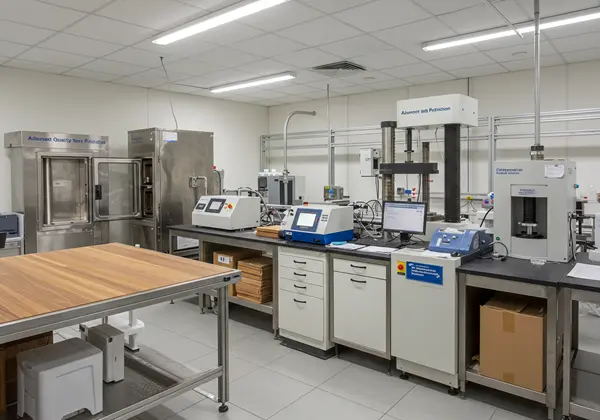
Timber is Formed by Nature. Consistency is Bound by Engineering.
Every timber flitch carries local geographical variations, growth stress rhythms, and organic anomalies. Our technical baseline does not look to homogenize natural timber variations; instead, we catalog and isolate them with geometric accuracy. By auditing cell wall integrity, anisotropic fiber tension, and density grading across every production batch, Chuanfoo Wood transforms natural growth patterns into predictable, structurally optimized architectural components suited for secondary pressing lines.
Log Extraction Rigor
Sourcing targets are limited to timber blocks exhibiting uniform ring structures and optimal sapwood-to-heartwood configuration to maximize yield stability.
Sequence Continuity
Flitches are structurally indexed, physically numbered, and bundled in precise extraction sequence to ensure uniform grain alignment during downstream layup.
Substrate Compatibility
Surface tension and thickness uniformity are optimized to withstand high industrial pressures and temperatures without adhesive bleed-through.
The 7-Stage Veneer Slicing Protocol
A fully audited sequence governing raw log preparation through vacuum thermal processing to final dimensioning.
Flitch Selection & Squaring
Raw veneer logs undergo metal detection and automatic debarking before being hydro-axed into uniform rectangular processing flitches.
Hydro-Thermal Conditioning
Flitches enter computerized vats for precise water cooking (up to 90°C depending on species) to soften lignin structures and prevent slicing shears.
Guided Slicing Operations
Utilizing high-speed horizontal or stay-log cutting configurations to achieve flat-cut or quarter-sliced architectural veneers with zero vibration lines.
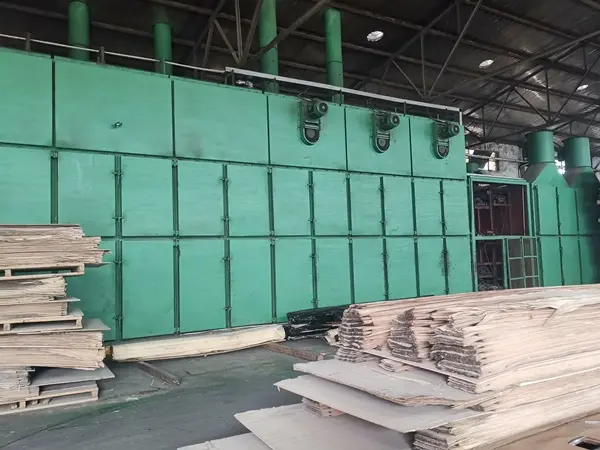
Jet-Belt Tension Drying
Slices progress directly into multi-zone jet dryers under strict speed controls, targeting an optimal 8% - 12% moisture equilibrium.
Densitometric Grading
Each individual sheet is manually inspected, organized by grain frequency, and grouped under architectural AAA, AA, or A parameters.
Fleece Backing (Optional)
Advanced continuous pressing applies non-woven reinforcement fleece using eco-compliant, temperature-resistant bonding compounds.
Hermetic Vapor Packaging
Bundles are clipped, dimension-verified, wrap-sealed with moisture barriers, and packed on reinforced ISPM-15 export pallets.
Engineering Tolerance Specifications
We maintain absolute transparent metrics. Our structural values are quantified using standard calibration tooling.
| Technical Parameter | Standard Operational Limit | Verification Methodology |
|---|---|---|
| Moisture Equilibrium | 8.0% – 12.0% Maximum Range | Pinless electromagnetic wave scanning post-kiln drying. |
| Thickness Micro-Tolerance | ±0.02 mm Variance Across Sheet | Continuous digital micrometer testing at 6 distinct points. |
| Surface Planarity | Sanded smoothly up to 240/320 Grit | Laser surface profile assessment to limit downstream checking. |
| Formaldehyde Classification | ≤ 0.05 mg/m³ (E0 & CARB P2 Compliant) | Desiccator emission cell evaluation in certified internal lab. |
| Layup Press Resistance | Withstands up to 130°C / 12kg/cm² | Hydraulic simulator test ensuring no fiber structural cracking. |
Controlling Internal Growth Stress
Why do architectural veneers suffer checking or structural splits when leaving production yards? The root cause is volatile cellular water retention.
Wood fibers remain naturally reactive to changes in local vapor pressure. Inadequate or accelerated flash drying leaves localized pockets of moisture trapped inside the cell cores.
Our automated jet-belt thermal control line slowly reduces moisture down to an 8-12% baseline. By stabilizing cellular structures prior to final trimming, we ensure our veneers maintain dimensional stability, whether bound for humid tropical developments or arid northern markets.
Certified Environmental Integrity
All Chuanfoo Wood products are manufactured under rigid environmental and trace parameters. We process exclusively using non-toxic water-based compounds and low-VOC treatments, allowing our partners to enter high-end commercial projects, premium cabinetry production, and sustainable luxury hospitality developments worldwide.
Batch Consistency at Scale
Whether completing an individual custom run or importing bulk container loads, our technical sorting controls minimize batch-to-batch structural variance. Contract buyers utilize our 20+ year manufacturing capacity to secure:
Color Metric Matching
Advanced visual sorting groups veneer sheets into micro-tonal classifications, preventing sharp shifts across continuous walls.
Grain Architecture Stability
Strict monitoring isolates crown, half-crown, and straight rift grain behaviors to match specific layout blueprints.
Continuous Supply Capacity
With massive raw material reserves, we guarantee identical species replenishment options over extended project timelines.
Batch Data Traceability
Every shipment contains clear identification tags tracing back to specific log batches, slicing runs, and drying parameters.
The Chuanfoo Quality Framework
We explicitly stand behind the industrial performance of our raw veneer products. Our operational risk framework covers the downstream supply chain through a binding defect protocol:
Fully Audited Traceability: Complete processing transparency from log extraction through delivery.
Third-Party Verification: Random laboratory confirmation of all moisture and emission data metrics.
Direct After-Sales Channels: Straightforward coordination with engineering staff regarding pressing parameters.
Defect Structural Protection: Contractual warranty replacement covering out-of-tolerance slicing deviations or structural manufacturing defects.
Your operational delivery remains our primary baseline.
Initiate Technical Verification
Request physical sample bundles for hot-press testing, access full engineering sheets, or connect with our manufacturing team.